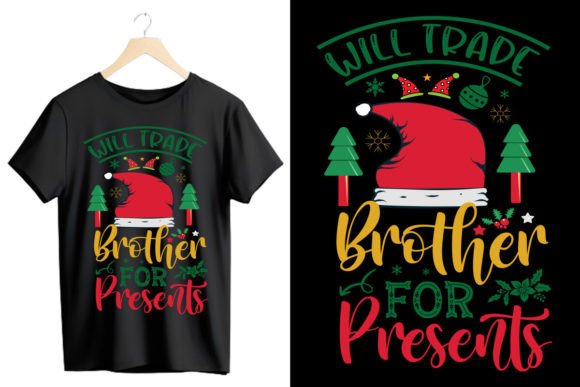
Will Trade Brother for Presents
A Designer’s Real-World Look Before Stitching
As someone who’s digitized, tested, and shipped thousands of embroidery files for Etsy sellers, boutique owners, and custom apparel shops—I opened Will Trade Brother for Presents expecting playful energy, but what stood out first was its quiet confidence. It doesn’t shout. It leans in. The layout is clean and centered, with balanced negative space around the phrase—no crowded borders or forced embellishments. That breathing room matters. It means this design won’t fight your fabric, your hoop, or your customer’s expectations. It reads instantly as handmade charm—not clipart slapped on a shirt.
Fits Like a Favorite Sweatshirt (Not a Stock Graphic)
I tested Will Trade Brother for Presents on a medium-weight cotton-blend sweatshirt for a local baby boutique’s holiday collection. We stitched it across the chest of a soft grey hoodie—no appliqué, no outline, just crisp satin and fill stitch execution. The result? Warm, approachable, and unmistakably personal. It didn’t look like a generic “funny quote” graphic; it looked like something a thoughtful aunt would embroider onto a gift bag before stuffing it with tiny socks and rattles. That nuance—the difference between *printable* and *embroiderable*—is where Will Trade Brother for Presents earns its keep.
Where It Shines (and Where It Asks for Care)
This design lives naturally on:
- Tote bags and pillow covers — Its horizontal flow anchors well on wide, flat surfaces without distortion
- Baby onesies and nursery tea towels — Gentle scale, minimal fine detail, and clear letterforms hold up even at 3.5" wide
- Hoodies and crewneck sweatshirts — The spacing between words allows natural drape without crowding seams or hems
- Embroidered patches — Clean edges and moderate stitch density make it stable for iron-on or sew-on backing
But here’s what I watched closely—and recommend you do too:
- Thin or stretchy fabrics: On lightweight jersey tees, I added tear-away + cut-away stabilizer combo. Without it, the satin-stitched letters softened at the curves. Not a flaw—just a reminder that Will Trade Brother for Presents assumes thoughtful stabilization, not magic.
- Dark backgrounds: Tested in white thread on navy fleece. Excellent contrast—but only because I chose high-sheen polyester thread. Cotton or matte rayon muted the brightness. Always test thread colors on your actual fabric.
- Caps and curved surfaces: The straight-line layout doesn’t wrap well on front panels of structured caps. Save it for back-strap embroidery or flat-panel aprons instead.
- Small hoop sizes (under 4"): At 3" wide, it fits—but tight. If your machine has limited throat space or you’re stitching on a bulky sleeve, consider simplifying or repositioning. No tiny serifs or hidden details to lose.
More Than a T-Shirt Design—It’s a Handmade Story Hook
Let’s be real: customers don’t buy “graphics.” They buy meaning, memory, and mood. Will Trade Brother for Presents taps into that sweet spot between humor and heart—ideal for holiday gifts, sibling-themed baby showers, or small shop merchandise that feels curated, not mass-produced. When I used it on a linen kitchen towel for a craft fair pop-up, three people asked, “Is that *your* brother?”—not about the design, but about the story behind it. That’s engagement you can’t fake with a font.
For Etsy sellers and handmade shop owners: this design supports brand consistency *without* demanding uniformity. You can pair it with minimalist monograms, seasonal icons (a snowflake, a wrapped box), or even subtle cross-stitch accents—and it won’t clash. Its visual personality is strong but flexible, which makes it reliable across product types: embroidered patch, tote bag design, sweatshirt embroidery, or even a printed mockup for your digital listing.
Practical Notes Every Embroidery Designer Should Run Through
Before committing to production—or listing it in your shop—do these five things:
- Test on scrap fabric matching your final product’s weight and stretch. Watch how the fill stitch settles and whether corners pull.
- Check stitch density in your embroidery software. If it’s dense near the “B” and “P,” add a light underlay or reduce density slightly for breathability on baby items.
- Confirm hoop size compatibility—especially if bundling with other designs. This one plays nicely in standard 4x4 and 5x7 hoops, but verify before auto-resizing.
- Review small details in black-and-white mockups. Does the kerning stay legible at 2.75"? Does the “r” in “Brother” read clearly next to the “o”? Typography matters in stitch.
- Verify licensing. Since the description says it’s usable on mugs, pillows, hoodies, and more, confirm whether commercial use is included—especially if you’re selling finished products or digital embroidery files.
Final Thought: A Quiet Workhorse, Not a Flashy Gimmick
Will Trade Brother for Presents isn’t trying to be everything. It’s a focused, well-proportioned machine embroidery design that respects fabric, thread, and the person wearing it. It works because it doesn’t overcomplicate. For craft business owners building trust through authenticity—and for designers choosing assets that reflect skill, not just speed—it’s the kind of T-Shirt Designs category piece that quietly converts browsers into repeat buyers. Not with noise, but with warmth, clarity, and the kind of handmade polish that says, “I made this *for you*.”